
Over the past couple of decades, the construction industry in America has begun incorporating a structural material that is both old and new: mass timber. As this building technology has proliferated, New Energy Works has evolved alongside it and incorporated mass timber into our work. We’re obviously huge fans of building with wood for a wide variety of reasons. Now with mass timber, there are more possibilities than ever. Here’s what it is, why it matters, and why so many architects and developers are embracing it.
What Is Mass Timber?
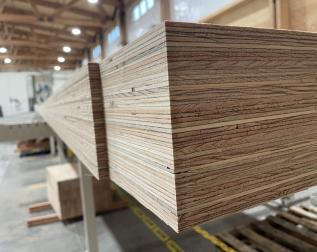
Mass timber refers to a category of engineered wood products made by bonding layers of wood together to create large, solid structural panels, beams, and columns. Unlike traditional “stick framing,” which uses small pieces of lumber assembled on-site, mass timber components are manufactured in a controlled environment and delivered ready to install.
Common mass timber products include:
- Glue-Laminated Timber (Glulam) – Beams or columns formed by gluing together layers of lumber with the grain aligned in the same direction. Glulam members can be straight or curved.
- Cross-Laminated Timber (CLT) – Large panels made by layering boards in alternating directions and bonding them with structural adhesives.
- Nail-Laminated Timber (NLT) and Dowel-Laminated Timber (DLT) – Panels assembled using nails or hardwood dowels instead of adhesives.
- Mass Ply Panels (MPP) – Similar in concept to common plywood, these panels are built out of many layers of wood veneer and adhesive.
These products create structural elements that rival steel and concrete in strength and stability, while offering unique architectural and environmental advantages.

Strength and Performance
One of the most common misconceptions about wood is that it’s only suitable for small buildings. In reality, engineered wood products are highly predictable and structurally robust. Mass timber materials are made of layers of wood bonded together, and depending on how those layers are configured – how the wood fibers are interacting and reinforcing each other – the panel, beam, or column will have different strengths.
CLT panels, for example, distribute loads in two directions due to their cross-laminated configuration – the direction of the wood grain alternates each layer - making them ideal for floors and walls. Glulam beams take the same principal but the wood grain is aligned, allowing the glulams to span long distances – longer than traditional heavy timbers can achieve. These are often used in large open spaces like airports, gyms, and assembly halls.
Mass Timber and Fire
Mass timber also performs well in fire conditions. When considering fire-resistant building materials, wood may seem counterintuitive, but it actually maintains its strength better than steel when exposed to fire. Large timber members char on the outside when exposed to flame, forming a protective layer that then insulates the inner core and preserves structural integrity for a predictable length of time.

Metal structures, on the other hand, lose strength quickly when exposed to the high temperatures of a building fire, even though they do not combust. Since the heat travels easily through the metal, the structural integrity is compromised throughout (no “inner core” is protected) and the structure can collapse suddenly. The “sacrificial charring” that occurs in timber construction allows engineers to design buildings that meet stringent fire-resistance ratings.
Sustainability and Carbon Impact
The most compelling argument for mass timber is its environmental profile. At New Energy Works, we are guided by the Triple Bottom Line, a business methodology placing equal importance on people, planet, and profit. Part of the reason we work with wood and are excited about mass timber is that it provides solutions for construction while mitigating environmental impacts.
Concrete production is responsible for a significant share of global carbon dioxide emissions, and steel manufacturing is also energy intensive. Wood, by contrast, stores carbon absorbed from the atmosphere during a tree’s growth. When sustainably harvested and used in long-lived buildings, that carbon remains sequestered for decades.
Sustainable forestry practices are central to this equation. Many mass timber projects rely on wood certified by organizations such as the Forest Stewardship Council, which promotes responsible forest management.
Additionally, because mass timber components are prefabricated, construction sites tend to generate less waste and experience fewer deliveries. That means reduced emissions from transportation and less disruption to surrounding neighborhoods.
Speed and Efficiency in Construction
Another major advantage of mass timber is speed.
Because panels and beams are manufactured off-site using digital fabrication tools, they arrive labeled and ready to assemble. This process—sometimes described as “kit-of-parts” construction—can dramatically shorten project timelines.
For developers, faster construction means earlier occupancy and reduced financing costs. For urban sites, it means less noise, fewer truck trips, and shorter periods of disruption.

Design Aesthetics and Human Experience
Beyond performance and sustainability, mass timber offers something harder to quantify: an intrinsic human connection. There's a warmth that exists between us and this ancient building material. Exposed wood interiors create a biophilic connection to nature, which research links to improved well-being and productivity. Offices and schools built with visible timber often feel more inviting than their steel-and-concrete counterparts.
Architects also value the material’s versatility. Timber can be left exposed for a natural look or combined with steel, glass, and concrete in hybrid systems. The precision of CNC manufacturing allows for complex geometries and clean detailing. The look of mass timber components can be drastically changed by adding custom finishes like paints, stains, and textures. If you’re integrating glulams with traditional timbers, you can even grain-match the two so that they blend seamlessly.

The Future of Building
Mass timber sits at the intersection of tradition and innovation. It draws on centuries-old knowledge of wood construction while leveraging modern engineering, digital fabrication, and sustainability practices.
As cities and builders face the need for faster, cleaner construction methods, mass timber offers a compelling alternative to business as usual. It may not replace steel and concrete entirely, but it is expanding our concepts of what’s possible.
Are you interested in integrating mass timber in your next project? Reach out to us to learn more about our services and how we can help implement this innovative material in your commercial or residential project.
Or come find us in person: New Energy Works will be exhibiting at the 2026 International Mass Timber Conference in Portland, Oregon. It will be a great opportunity to discuss our mass timber projects and see what else is happening in the world of mass timber. Come see us at Booth #1007, March 31 – April 2.