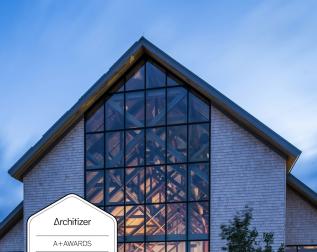
Doors are the transitional pieces, the welcoming elements, the room dividers, the barriers against intrusion—be it weather or other diversions. A highly-crafted door is designed to function flawlessly and be in service for decades.

While chatting about the overall presence a home has—how it speaks to family, visitors, and neighbors alike—entry doors became a pointed topic. This sparked a more in-depth conversation with our fine woodworking division, NEWwoodworks general manager, Rob, and Jay, the team’s door guru.

Entry doors, barn doors, interior doors, flat track doors—NEWwoodworks crafts them all. What drives passion for wooden entry doors? Aesthetics, customization, tradition…Jay explained, “You can do a lot more with wood than you can with metal or fiberglass. Yes, they can at times be more expensive and may require more maintenance, but that door is going to be the first thing your guests will see and touch when you welcome them into your home. Wooden doors feel warmer, they shut with a solid feel, and there is so much more character and story in wood than any other material.”

Envisioned by our design team and clients, or by outside architects and designers, or purely by our woodworker’s knowledge and creativity, each door is one-of-a-kind with designs that grow out of original ideas through revisions and thoughtful purpose-driven review. “We try to balance other visual elements on the exterior and interior of the house within the final design and functionality of our doors,” elucidated Rob. Surrounding features including timbers, radiused entryways, location (overhangs, protection or exposure to the elements), and physical needs such as ADA compliance, privacy desires, or security all play a role. “We keep any special use requirements in mind as well as the personality of the home and the homeowners.”


How about the nuts and bolts? Or the wood, hardware, core, weather, and shipping of these doors. If you have ever swung a thick wooden door open with just two fingers, smooth as silk, and felt it click and seal solidly into place behind you, then you know the magic of a custom door.

Wood: “What’s great is having access to Pioneer Millworks (our sister company) reclaimed wood yard. Our new CLT shop is literally surrounded by their yard and there’s nothing quite like walking the stacks to find some cool reclaimed wood for a door,” Jay told us. “There are more challenges with reclaimed material, the main ones are the waste factor and fanatic attention to detail that’s required machining it. During fabrication, it’s vital to keep the end use in mind–the position of defects or signs of the wood’s previous life in the finished door is critical.”


Hardware: Turns out the craftsmen at NEWwoodworks are a bit obsessed with how a door swings open and closed. With a smile acknowledging his hardware obsession, Jay said, “Most commonly a high-quality ball bearing steel, brass, or bronze hinge is employed. How many hinges that we use on the door is mainly determined by the height and weight of the door. The size of the hinge is determined by the thickness of the door. Another big secret is in securing the jamb side of the hinge into the framing of the structure—its the key to keeping that door where the Installer put it.” Solid bronze or brass handles are a favorite, incorporated with a mortise style lock, they are one of the most secure options we’ve found for entry doors.

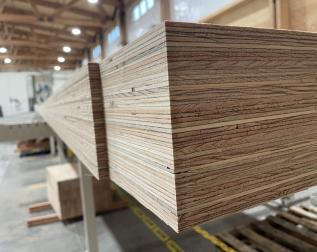
Torsion Box and Stave Core: “We were looking for a way to make an insulated, lighter weight, flat, and stable substrate for veneering wear-layers for custom entry doors and architectural flush doors,” Jay explained. “We engineered a torsion box which has a core of dense polystyrene foam cut to fit within a plywood or stave core/solid grid which is cut out on our CNC and then vacuum sandwiched between ply skins.” Solid wood veneers, ends, and edges encapsulate the boxes. Torsion boxes are built at varying thicknesses for each specific project.


Rob added, “We’ve found other useful applications for the torsion box including table tops, particularly large conference tables.” Stave cores have similar capabilities and properties as the torsion boxes but are crafted of Douglas fir in Idaho by a fellow chain of custody FSC company. “Both torsion boxes and stave cores allow us to utilize wear layers (veneers) of a variety of species or to custom cut veneers for book matching of stiles and rails in particular. They help mitigate warping, cupping, bowing and twisting in the final door.”

Weather: Which direction will the door face? How will it be protected from the weather (with an overhang for example)? As it turns out, there are specific recommendations on the height of the door versus the overhang required to adequately protect it from the weather. This is mainly used for wood doors. Jay explained further, “We build our doors to a tight tolerance to seal out drafts and moisture penetration as much as possible. We’ll incorporate flipper seal weather-stripping and adjustable door sweeps and dust brushes. To encourage proper water shedding we bevel the tops of the rails so there is no pooling or seeping into panel grooves.”


Shipping: For our team, crafting a door also means incorporating the door, windows, weather-stripping, hardware and interior/exterior trim into a pre-assembled, fully set up, easy to install door unit. The last step (if the door is shipping out rather than being hand-delivered): making the crate. A crate is made to hold up against the brutality that can occur with shipping across the nation. “We ship most of our door units under 72″ wide as a pre-assembled and pre-hung unit.”


What are our favorite doors? Rob said it best: “Can’t choose just one.” Personal preference rules and the possibilities are nearly unlimited. Customization opportunities abound from wood species choice to hardware selection and inclusion–or exclusion–of windows.
Solid brass, stainless steel, bronze, nickel, wood, oh my! Hardware styles vary widely from type of metal to shape, size, and finish. “We have favorites and preferences certainly, but the client’s desires, hardware durability, and overall aesthetics drive the final decision. There are times we require, or desire, custom hardware. In those instances, we work with outside vendors or even create it on our own,” Rob said. So personal is hardware, that at times it comes down to viewing the color or finish (hammered, brushed, smooth, etc) and literally touching or experiencing the material in person for the architect, designer, or client to make a final call.


Windows in the door, as sidelights, or transoms bring more light into entryways and allow greater views to the outside. “I feel like we have more sidelights and transom windows when there is a view to capture, or a larger entryway that could use extra light,” explained Jay. “If security is a concern, we can still create a grand entryway, but we may push the windows higher and keep them more modestly sized. Custom windows are fairly common within our projects—we’ve incorporated some really neat stained glass and collages here and there.”


Want more doors? A few more of our “most clicked” doors (entry and other) are below. For the full gallery, visit NEWwoodworks doors. Have a door idea you want to make reality? Call (585.924.3860) or email us.


Flat Track Doors Continue are a popular ‘click’ item: